North West Radiotherapy Network pilots successful T Level small team project

Introduction
The North West radiotherapy specialised services clinical network (SSCN) collaborated with The City of Liverpool College to offer a T Level industry placement small team project to develop an information platform that improves patient access to clinical trial information. The platform ensures that information for patients is accessible and understandable, whilst serving as an opportunity for students to develop their IT competence. This project demonstrated how supporting T Level learners can deliver innovative solutions while building the future workforce.
Key benefits and outcomes
- Supported T Level learners studying Digital Software Development to develop their skills whilst having a direct beneficial impact on patients.
- Facilitated the use of technical expertise which otherwise would not have been viable due to lack of organisational resource.
- Successfully demonstrated a model that can be scaled across the country and repeated with further cohorts of T Level students, supporting network ambitions and positive patient outcomes.
What the organisation faced
The North West radiotherapy SSCN is the largest of eleven networks in the UK and works collaboratively across radiotherapy providers in the region, including The Christie NHS Foundation Trust, Clatterbridge Cancer Centre and Lancashire Teaching Hospitals.
The network identified a challenge around making radiotherapy clinical trial information more accessible and understandable for patients. Patients struggled to identify relevant clinical trials as existing information was often highly technical, difficult to navigate and inconsistent across organisations.
The network also faced capacity and resource pressures common across the NHS, with limited digital development resource and protected time available to build the digital platform.
What the organisation did
With this aim to improve access to clinical trials in mind, plus an ambition to explore innovative ways of engaging with education providers and widening awareness of non-clinical careers within the NHS, the network engaged Digital Production, Design and Development T Level students (now Digital Software Development) at The City of Liverpool College to create a digital tool.
The network worked with the college to develop a radiotherapy clinical trials dashboard and patient information platform. Over two years, approximately 35 T Level students have worked on the project as part of small team project (105 hours) within their industry placement hours. Delivery was primarily hybrid, involving remote development work, online meetings and feedback sessions and stakeholder reviews. Throughout the development, the network and other NHS partners provided ongoing supervision and guidance.
‘…even though the students are supporting a network project, the day-to-day management is provided by the college – which works really well for us’
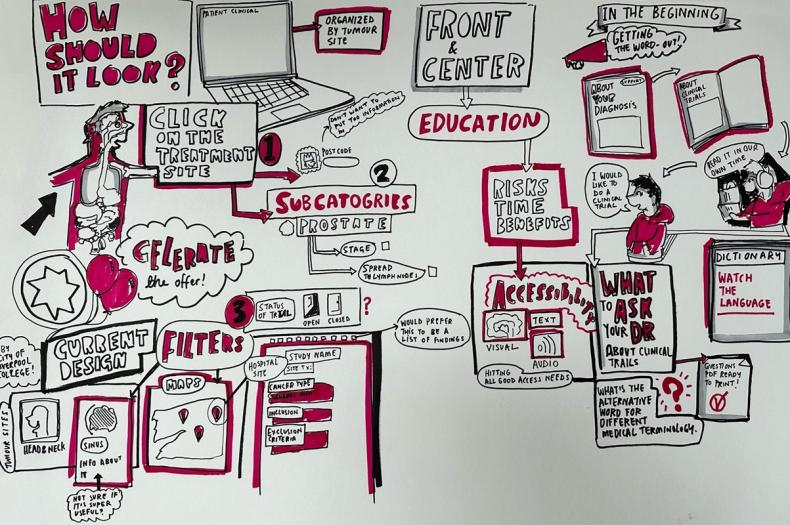
The students designed the platform using visual and anatomical navigation tools rather than relying solely on clinical terminology to improve accessibility. The dashboard allows patients to search by hospital or body area, view trial summaries and access information before clinical appointments. It also allows NHS teams to maintain and update content without extensive technical intervention.
Below is an image that the students designed to show the way they hoped the new system would work.
Results and benefits
Increased organisational capacity
The collaboration provided the network with additional digital development capacity and access to specialist skills that may otherwise have been difficult or costly to secure. NHS staff highlighted the value of having access to high-quality digital, data and design expertise through the T Level partnership.
Improved patient accessibility
By simplifying navigation and using visual tools, patients will be better able to understand available trials and have more informed conversations with healthcare professionals. Typically, around 5 per cent of patients enrol on oncology clinical trials. The dashboard aims to reduce barriers to increase enrolment numbers.
The project also aimed to reduce the postcode lottery effect by helping patients identify trials available across the wider North West region rather than only at their local hospital. This aligns with the larger network ambition to better integrate clinical trial enrolment between radiotherapy providers on a regional basis.
Sustainable partnership model
The network and college developed an ongoing partnership model where future T Level cohorts can continue maintaining and improving the platform. This creates continuity for the organisation while giving new T Level students access to live industry projects each academic year.
In addition, this agreement is of benefit to the network, as they have a sustainable model for hosting and maintaining the dashboard into the future.
Enhanced student experience and employability
Students gained experience working on an enterprise-level NHS digital platform, developing technical, communication and project management skills in a live work environment. Many students reported feeling proud to contribute to a project that could directly benefit their local community and families affected by cancer.
The project also broadened students’ awareness of digital careers within healthcare, helping them recognise how transferable their skills are across industries.
‘…it helps support the talent pipeline by showcasing the breadth of careers available within the NHS, including roles such as BI analysts, clinical scientists and radiotherapy engineers, as well as pathways into more technical roles’
Takeaway tips
- Digital T Level pathways can support NHS workforce challenges beyond traditional clinical roles.
- Partnerships between NHS organisations and education providers can create sustainable solutions that benefit both employers and students.
- T Level students can make meaningful contributions to complex NHS digital projects when supported through structured employer-led projects.
- Real-world projects help students understand the wider social impact of their work and strengthen employability skills.
- Long-term collaboration models allow organisations to build ongoing capacity while maintaining continuity across student cohorts.
Contact details
For more information about the work in this case study, please contact the-christie.northwestrodn@nhs.net.


