Guidance

Employer guidance for calculating statutory minimum wage rates

An overview of National Minimum Wage and National Living Wage, how they apply in the NHS, and the main steps employers should take to stay compliant.

Published date: 14 March 2025

Last reviewed: 22 July 2026

Key points

  • Where reference has been made to “National Minimum Wage”, this includes the National Living Wage and the National Minimum Wage.  

  • This information has been independently reviewed and updated by an external organisation and was confirmed to be accurate as of July 2026. 

The National Minimum Wage

Binoculars in a blue circle

Disclaimer: The advice in this guidance is generic only.  

Both the National Minimum Wage (and tax) legislation can be complex and will be fact specific where you may need to seek advice from your benefit provider and/or seek independent tax advice. 

Paying staff at least the legal minimum is a basic employer responsibility. For most NHS organisations this is manageable, but there are still areas where errors can happen, especially around unpaid extra hours, salary sacrifice, working time, and deductions from pay. 

This web page explains the key points in a practical, NHS-focused way. 

  • The National Living Wage (NLW) and National Minimum Wage (NMW) are the minimum hourly rates employers must legally pay to all workers regardless of the size of the business.  

    The minimum wage a worker should receive depends on their age and whether they are an apprentice.  

    In general: 

    • workers aged 21 and over are entitled to the NLW
    • younger workers (aged 20 and under) and apprentices are entitled to the relevant NMW rate.   

    Be careful not to confuse the National Living Wage with “The Real Living Wage”, which is a voluntary rate employers can choose to pay and is typically set higher than the government mandated legal minimum wage rate.   

  • From April 2026, The Fair Work Agency became responsible for enforcing worker rights and this includes NMW compliance and there are financial penalties and reputational damage associated with getting NMW compliance wrong. 

    NHS staff are paid above the legal minimum rate. However, minimum wage compliance is not just about headline salary. 

    Employers also need to consider: 

    • how many hours the worker is actually working (this can include contractual hours and additional time worked voluntarily)
    • whether additional time worked is considered and paid for 
    • which parts of pay count towards NMW 
    • whether deductions from pay or salary sacrifice arrangements reduce pay for minimum wage purposes. 

    A worker may appear to be paid well overall, but they could still fall below minimum wage once the legal calculation is applied. 

  • Minimum wage rates are set by government each year following recommendations from the Low Pay Commission (LPC).   

    The current minimum wage rates can be found on the GOV.UK website

    For NHS employers, it is good practice to review minimum wage compliance each year when: 

    • statutory NMW rates change 
    • pay awards are announced 
    • local pay arrangements are updated 
    • on an individual basis, there have been changes to pay deductions, salary sacrifice arrangements and changes to pay and/or reductions to hours worked. 
  • Since the NLW was established in April 2016, Agenda for Change pay rates have generally remained above minimum wage levels. Even so, NHS employers should still review local arrangements carefully, particularly for lower-paid staff. 

    The table below shows the 2026 NMW rates set by government and the hourly rate of pay at the bottom of the Agenda for Change structure (closed band 1 and band 2). 

    1 April 2026 position:

    Year 

    National Living Wage hourly rate 

    Band 1 (closed) and band 2 entry level hourly rate 

    2021 

    £8.91 

    £9.49 

    2022 

    £9.50 

    £10.37 

    2023 

    £10.42 

    £11.45 

    2024 

    £11.44 

    £12.08 

    2025 

    £12.20 

    £12.36  

    2026 

    £12.71 

    £12.92 

How to calculate National Minimum Wage

NMW is calculated using an hourly rate and applies to all eligible workers even if they are not paid by the hour. For employers, this means that regardless of how someone is paid, employers need to work out a worker’s equivalent hourly rate to ensure they are being paid at the legal minimum wage in a pay reference period (PRP).  

There are a number of steps employers need to take to ensure they are calculating NMW pay correctly. The following diagram sets out the steps to follow.  
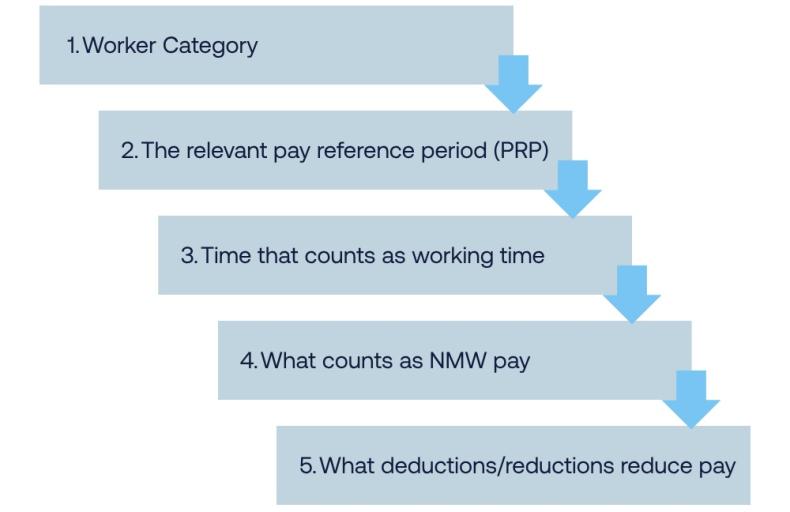
Image showing the steps to calculating NMW pay correctly

Further information for each step is highlighted below. 

There is also a set of  frequently asked questions (FAQs), split into themes, at the end of this guidance which are reflective of the most popular questions asked by employers. 

Step 1: Worker category

Confirm the individual is an employee who is working for the NHS. Most people employed by NHS organisations under a contract of employment will count as a worker for minimum wage purposes if they: 

  • have a written, verbal or implied contract 
  • are required to do the work personally 
  • receive something of value in return, such as pay or benefits 
  • are not genuinely self-employed, which would include individuals engaged through personal service companies who are considered to be outside IR35. 

Next, identify the work category. There are four different work types that make up the basis of  NMW calculations. It is important for employers to first establish which worker type each staff member is, then to work out their equivalent hourly rate to ensure they are being paid at least the NMW. 

Most workers are entitled to the minimum wage, but there are some exemptions. 

1. Salaried hours work 

This usually applies where a worker: 

  • is paid an annual salary 
  • has a contract of employment for a set number of basic hours across the year 
  • is paid in equal instalments across the year.

Read more about salaried work on the GOV.UK website.

An icon of a tick

Example: Annual salary of £30,000 paid in monthly equal instalments. 

Hours of work are Monday to Friday 9am to 5pm with one-hour unpaid lunch break.  

Basic annual hours would be 35 hours per week x 52 weeks (or any other denominator used to calculate annual hours, e.g. 52.14, 52.18).

Risk area: unpaid extra hours.  
If additional hours are worked but not paid or offset through time off in lieu (TOIL), this may create a breach. 

2. Time work - paid by the hour 

This is usually the simplest category. It applies where a worker: 

  • is paid an hourly rate

  • is paid for all time worked in each pay reference period (PRP) so pay can vary in relation to time worked in each PRP, which can be weekly, monthly etc (see step 2 below).

Read more about time work on the GOV.UK website.  

The NMW must be met in each PRP separately. Higher pay or overpayments from one PRP cannot be used to cover a shortfall in another. The only exception is where a payment (or adjustment to pay) in the next PRP relates to work done (or adjustment due) in the previous PRP, for example, overtime worked late in the period that misses the payroll cut-off and is paid in the following PRP, or an adjustment to pay for absence. 

An icon of a tick

Example: Employee is paid £14.50 per hour.  

Working hours are 40 hours per week, Monday to Friday. 

Weekly pay would be actual time worked in the week x £14.50.  

Monthly pay would be actual time worked across the number of days worked in the month x £14.50. 

Risk area: additional working time incurred not captured for payment. 

3. Output work 

This applies where a worker is paid for output, such as the number of tasks completed or items produced (piece work).  

This is less common in NHS settings. 

Read more about output work on the GOV.UK website. 

Risk area: pay falling below NMW rate due to unrealistic piece rate targets. 

4. Unmeasured work 

This worker type applies where the work does not fit the other three categories and can also apply to work where certain tasks are to be carried out but they vary and are not paid per task performed.   

Unmeasured workers must be paid for the actual time worked in a PRP or have a daily average agreement in place at the start of their employment.  

Read more about unmeasured work on the GOV.UK website. 

An icon of a tick

Example: £14.50 per hour times actual time worked in the pay period or under a daily average agreement a worker is paid an hourly rate for set hours. 


Step 2: Pay reference period (PRP)

The PRP is the period used to check whether the worker has been paid at least minimum wage.   

A PRP can be up to one calendar month, but not longer, for example:

  • weekly paid (PRP is one week)
  • two-weekly paid (PRP is two weeks) 
  • four-weekly paid (PRP is four weeks)
  • monthly paid (PRP is one calendar month).

A worker must be paid at least the minimum wage for the actual time worked (or deemed time worked) in each PRP. 

Step 3: Working time

For minimum wage purposes, working time is generally any time when an employer requires a worker to be somewhere, do something, or remain available for work. 

Examples of working time include: 

  • changing into uniform or personal protective equipment (PPE) at work 
  • setting up equipment before a shift 
  • paperwork or admin after a shift 
  • mandatory training outside normal hours 
  • handovers or team meetings outside rostered time 
  • travel between sites or appointments during the working day 
  • travel time in community roles where travel is part of the job. 

What does not usually count includes: 

  • normal home-to-work travel 
  • normal travel from home to college or training (unless actually working, e.g. responding to, preparing emails, admin tasks whilst travelling on a train) time spent away overnight when no actual work-related tasks are undertaken. 
An icon of a tick

Example: NHS staff can continue to work beyond their contractual hours, for example, due to urgent care needed.  

This additional time would be considered working time and should be factored into the overall calculation of actual time worked in a PRP.

Step 4: Pay that counts for NMW

Not all pay elements count for NMW purposes and some pay elements are treated differently across the different work categories.  

Wrongly including an element of pay that doesn't count, for example an overtime premium, can result in it appearing that the minimum wage is being paid when in fact it is not. 

Pay that usually counts 

The following payments count towards minimum wage pay: 

  • basic salary or wages
  • performance related bonus - for example annual bonus or quarterly bonus
  • commission payments (if a salaried worker is entitled to receive commission, they would not be treated as a salaried worker and default to unmeasured) – not relevant to the NHS 
  • overtime pay at the basic rate (associated time worked must also be factored into the calculation). 

Pay that usually doesn’t count 

The following payments do not count towards minimum wage pay: 

  • overtime premium payments (except for unmeasured workers)
  • allowances that are not considered consolidated into the overall pay arrangement:

    - reimbursement of work-related expenses  
    - benefits in kind (other than living accommodation) 
    - payment of a loan under a loan agreement 
    - advances of wages 
    - pension payments, e.g. receiving from other employments, State Pension 
    - lump sums on retirement 
    - redundancy, payment in lieu of notice (PILON), ex-gratia payments 
    - other payments received under settlement agreements 
    - rewards under staff suggestions schemes. 

In the NHS it is common practice for employees to be paid premium rates and/or allowances for: 

  • working in excess of contracted hours  
  • working unsocial hours at evenings, weekends, bank holidays.  
  • receiving the high-cost area supplement (HCAS) for working in London and the surrounding areas.  
  • recruitment and retention premia to address national skills shortages and can be paid short or long term.

Step 5: How deductions and reductions affect NMW pay

Some deductions and payments made in connection with a worker’s employment can reduce the pay used to calculate NMW. NMW legislation does not differentiate between a reduction to gross pay (for example, a salary sacrifice) or a deduction from net pay (for example, to pay for car parking). 

NMW compliance always refers to the gross pay before any deductions/reductions such as salary sacrifice are considered. Deductions from pay for NMW purposes can also include costs incurred by employees to pay for items that they need to do their job where the cost is not reimbursed by the employer.

Examples that typically reduce pay.

  • Buying required uniform items or a specific type or colour of footwear.
  • Car/transport deductions or payments where having the car is a requirement of the role (community worker, district nurse/midwife) - e.g. Fleet Solutions car arrangements.
  • Deposits for fobs, passes, keys if there is a requirement for staff to have these.
  • Admin charges linked to work arrangements, e.g. fees for processing DBS checks, payment charges for processing attachment of earnings orders or facilitating a payment to a third party. 

The table below illustrates how payments from a worker and deductions taken via payroll are treated for NMW compliance purposes using a uniform requirement as an example:


Deduction by employer 

Payment from worker to employer 

Payment from worker to third party where the cost is not reimbursed 

All NHS workers are required to wear black trousers and black shoes  

Reduces NMW pay 

Reduces NMW pay 

Reduces NMW pay 

No uniform requirement 

Reduces NMW pay (unless paid to a third party - see end column) 

Does not reduce NMW pay 

Does not reduce NMW pay 

Examples that do not reduce pay.

  • Income tax and National Insurance contributions.
  • Trade union subscriptions.
  • Contractual deductions relating to conduct, e.g. parking fines, speeding tickets, lost locker keys/key fobs, damaged/unreturned work items.
  • Repayment of a loan or advance of wages under a formal agreement.
  • Recovery of overpaid wages.
  • Pension contributions made by the employee.
  • Payments not deemed in connection with employment or not for employer own use and benefit.
  • Voluntary payments by the worker for the purpose of purchasing goods and or services from the employer (unlikely to be relevant in NHS).
  • Accommodation (if less than the offset rate).

This list is not exhaustive but covers a number of the most common scenarios.

  • A deduction will usually reduce NMW pay if it is for the employer’s own use and benefit. Meaning, if there is a deduction taken from a worker where the employer holds or can use the money as they wish, or the deduction is used to pay an employer’s liability, that deduction will reduce NMW pay. 

    It doesn’t matter if the worker agrees to or receives preferential rates in this circumstance. 

    NHS examples may include: 

    • car parking charges where an NHS trust owns the car park
    • deductions for cars provided to workers where the arrangement/liability lies between NHS trust and car provider (not a salary sacrifice arrangement)
    • deductions for additional holiday purchases where the payment is taken throughout the year as a new deduction (outside of salary sacrifice)
    • deductions for electronic goods that are owned by NHS trusts. If the liability lies with the NHS trust and then they provide them to staff who then have a net deduction come from their pay (outside of salary sacrifice). 

    While deductions for own use and benefit taken via payroll will reduce NMW pay, a payment outside of payroll from worker to employer will not reduce NMW pay (for example, a direct debit payment from the employee’s bank account) unless of course that payment is to pay for items that are a requirement of employment. 

    Where these arrangements exist, the employer should review them carefully to ensure the correct treatment is applied to the NMW compliance check. 

    An icon of a tick

    Example: Car parking fees
    As long as there is no requirement for the worker to take up the service, (they can choose whether they want to take up the car parking or not), then a payment (for example, an invoice or direct debit) for car parking fees will not reduce NMW pay whereas a deduction from salary would.

    Below is an example of the difference between a deduction for 'own use and benefit' and a payment to the employer for the cost of an employer provided car parking space. 

  • A salary sacrifice arrangement is where an employee agrees to reduce their pay in return for a non-cash benefit – such as: 

    • lease cars 
    • bikes 
    • technology and white goods schemes 
    • childcare vouchers (closed to new participants) or workplace nurseries 
    • pension contributions (although not applicable for contributions to NHS statutory schemes). 

    Whilst salary sacrifice arrangements are commonplace, they are not recognised in the NMW legislation, therefore any reduction in pay as a result of an employee entering into a salary sacrifice arrangement results in a change to their contractual pay which means that the new, lower amount of pay is the amount considered for NMW purposes.  

    An icon of a tick

    Example: An employee chooses to salary sacrifice £1,000 of pay in exchange for a bike under the cycle to work scheme.  

    Gross salary of £35,000 is therefore reduced by £1,000, resulting in £34,000 post-sacrificed salary counting for NMW purposes.

    Key point: Salary sacrifice is a contractual reduction to gross pay and therefore will always reduce NMW pay.  

    Salary sacrifice arrangements can be tax-efficient and therefore a significant cost benefit to the employee, yet they can create a minimum wage issue if not carefully implemented and monitored regularly. 

    For more information about salary sacrifice schemes please see our  dedicated web page. 

    What employers should do

    All employers operating salary sacrifice arrangements should:  

    • check eligibility thresholds carefully to ensure continued compliance with minimum income requirements 
    • review arrangements regularly and ensure correct documentation is in place, e.g. variance to contractual terms on implementation, governance documentation 
    • ensure that consideration is given to the total of all salary sacrifice arrangements acknowledging that employees may have multiple benefits 
    • re-check them prior to each April when rates change 
    • review again when pay awards are announced and/or where there are changes to working hours (e.g. employee reducing contractual hours) 
    • understand how each scheme works in practice and query with the provider where appropriate, recognising that some benefit providers may operate schemes differently 
    • identify staff who may need manual intervention to remain compliant. 
  • Where an employer provides accommodation to an employee, special rules apply.  The government sets a daily 'accommodation offset' amount which employers must consider where accommodation is provided.   

    If an employer charges more than the offset amount the difference between the two amounts will reduce NMW pay. 

    It is important for employers to note that it does not matter whether this is a gross or net deduction, or whether the employer simply charges the worker by any other means, e.g. direct debit, bank transfer.  

    In addition, where there are any associated costs related to the provision of that accommodation, e.g. water, gas, electric, telephone etc. these also need to be factored into the overall accommodation cost and where the total exceeds the offset amount, the excess will reduce the worker's NMW pay in the period where the charge occurs. 

     An example is shown below: 

    An icon of a tick

    Example: An employee is provided with living accommodation by their employer. The current daily offset rate as of 1 April 2026 is £11.10.
     
    The employer charges the worker £500 per month for the accommodation. The offset is currently £333.00 in a 30-day month. 

    This means the workers NMW pay will be reduced by £167 (the difference) in that pay period.
     
    If £100 was also charged for utility costs, this would increase the excess to apply as a deduction to pay in the pay period to £267.

Frequently asked questions (FAQs)

  • Q1. Once a worker type is agreed, how can we easily identify which pay elements fall into the high-level categories? 

    Once the worker type is confirmed, the next step in a NMW calculation is to decide which pay elements do and don't count towards NMW pay – see step 4. HMRC’s online guidance also outlines the more common pay elements and their effect on each work type. 

    Q2. Would staff engaged on a casual/zero hours/bank agreement be considered an 'unmeasured worker'?  

    Casual/zero hours/bank workers will likely fall into either the 'time' or 'unmeasured' worker category. They are unlikely to meet 'salaried' work criteria as hours and pay for individuals on zero hours/bank contracts will likely fluctuate from one pay period to another due to the variance in hours being worked in each pay period. A casual employee who is not on a permanent contract but has guaranteed hours is likely to be a time worker. 

    Q3. Why is it important to identify worker category? 

    How you calculate a workers NMW hourly rate varies across each of the four worker categories.  Therefore, it is important to establish the correct category before undertaking any NMW check to ensure the correct pay, deduction and working time rules are applied to ensure the correct NMW entitlement is being met. 

  • Q4. If a worker is required to travel to a location other than their main place of work, e.g. an apprentice travelling to college on their study day, or an employee required to attend a meeting at a different office, does the travel time count as working time?  

    Normal home to work travel is not considered as working time for NMW purposes. This includes travelling from home to their normal place of work, their first task or first assignment of the day. The driving time from home to college and from college to home would not be considered as working time for NMW purposes.  

    Q5. If the individual attends their workplace first and then travels to a different location and returns back to their workplace before going home, will all travel time incurred count as working time?

    Some NHS trusts will operate over different sites where staff have to travel to undertake duties at another site, this time will count as working time. Similarly, staff may have roles where they are required to visit patients in their own homes, travel in these circumstances will also count as working time. 

    Q6. What are “excess hours”?  

    Most staff in the NHS are paid for additional hours worked; however, not all roles are contractually entitled to additional pay for extra time worked. Excess hours only accrue for salaried workers and are the hours worked over and above the basic contractual hours for which no additional pay has been received.  If these extra hours are not taken back by the worker as time off in lieu (TOIL), (and there are specific rules which apply where TOIL is considered for NMW purposes - see next question) the extra hours accrue throughout the NMW calculation year and if the actual hours worked in the year exceeds the basic annual hours before that year ends, the “excess hours” need to be taken into account in the NMW calculation in the relevant pay period and can result in a NMW breach.  

    Where overtime/additional hours are worked and paid in the pay reference period (PRP) where they are carried out (or in the immediately following PRP) they do not count towards an excess hours calculation. 

    Q7. In terms of excess hours, if an employee accrues TOIL for the extra hours worked, and takes these off at a future point, does this reduce the hours worked in future periods? 

    Yes, where an effective TOIL policy is in place, the intended outcome would be that the salaried hours worked do not exceed their basic annual hours throughout the course of their calculation year - which means no excess hours are worked. Good practice here includes a robust keeping of time and attendance records to track accrued hours throughout the year. 

    Q8. If an employee is required to travel and stay overnight for work, would their travel time count towards NMW pay? Would the time they stay away from home, but not physically working also count? 

    Where an employee is away from home for the purposes of work - you should consider what time is actually spent 'working'. Travel from home to a place of work, and from the place of work back home is not considered as working time.   

    Where they are carrying out tasks or required to be at or near a place of work, this will constitute 'working time'. Where they are not 'working', would not ordinarily be working and are not expected to work (for example, having dinner or in a hotel room watching TV) this would not constitute working time. If a worker travels from a place of work to another assignment/appointment - this is likely to be deemed as working time.  

    Attending conferences, workshops, training sessions voluntarily, but with employer approval is not considered working time, unless it is considered a mandatory or expected requirement of the employer.   

  • Q9. How often should salary sacrifice arrangements be checked to ensure on-going compliance?  

    Eligibility to participate in any salary sacrifice should be undertaken regularly and ideally as part of the payroll process for each pay reference period. The risk of a NMW breach increases where there are increases to the NMW rates (which includes annual increases or for example where younger workers have birthdays). Similarly delays/lack of pay awards can also impact on NMW compliance. Regular reviews to ensure continued NMW compliance are therefore important. Key stages for review include prior to the annual increase to NMW rates in April and when any changes are made to working hours and pay to check continued eligibility.  See the employers checklist under the salary sacrifice section for more detail. 

    Q10. If an employee enters into a salary sacrifice arrangement to obtain a car (through a lease or hire purchase scheme) because they require a car for work-related duties, but their employer does not provide one, does the salary sacrifice reduce their pay for NMW purposes?

    Where a salary sacrifice arrangement is in place - it will always reduce NMW pay. A salary sacrifice is a contractually agreed reduction of the workers’ salary in return for the benefit/service. The question references a situation where the employee needs a car to do their job role and that car is provided under a salary sacrifice scheme. In circumstances where an employee has a salary sacrifice car for their private use (with no business use) this is treated in exactly the same way for NMW purposes, in that any salary sacrifice will reduce NMW pay. 

    Q11. Can you convert part of a salary sacrifice reduction for a lease car to a net deduction if there isn’t enough pay, or should the salary sacrifice agreement cease and it be converted to a net deduction? 

    This would need to be looked at quite carefully. HMRC can challenge the validity of salary sacrifice arrangements which “switch” between a reduction to pay (a salary sacrifice) and the employee paying for the car via payroll out of net pay. This may create a problem for the entire scheme not just in relation to the individual concerned.  We would recommend that this is discussed with your benefit provider. 

    Q12. Where a salary sacrifice arrangement is converted to a net deduction and paid over to a third party, is the whole amount classed as a benefit in kind at this point? 

    Where the employer continues to provide the benefit which the employee previously salary sacrificed from their gross pay - but is now being paid from their net pay - the provision of the benefit in kind will still need to be reported on a P11D. However, the amount deducted will likely be regarded as 'made good' by the employee.  

    As noted in the previous question, care needs to be taken where salary sacrifice arrangements are changed during the benefit period to net pay arrangements. HMRC salary sacrifice guidance refers to a permanent change to an employee’s terms and conditions specifically in relation to their pay. Arrangements which move from salary sacrifice to net pay should be carefully considered with specific advice taken. 

    Q13. What happens when someone moves to half pay sickness or goes on maternity leave and has a salary sacrifice arrangement in place? 

    When a worker goes off on sickness absence and is receiving enhanced sick pay, i.e. not just statutory sick pay (SSP), a salary sacrifice can continue to be taken from the enhanced pay, but only if there is sufficient pay to do so. A salary sacrifice cannot legally be taken from statutory pay, as this would reduce pay below the statutory minimum payments.  Any salary sacrifice arrangements in place during periods of reduced or non-paid absences would need to be suspended or stopped until the employee returned to work. It is usual for this to be considered at the time the benefit arrangement is first put in place. 

    Where non-cash benefits are provided to employees on maternity leave, you will need to consider whether there is a legal requirement to provide that benefit regardless of the ability to reduce the employee’s salary.  

    Q14. What action can be taken to manage salary sacrifice arrangements when NMW increases cause staff to fall below the threshold, particularly where providers do not allow contract extensions to reduce monthly costs? 

    The arrangement must be adjusted immediately to remain compliant. This could involve reducing or suspending the salary sacrifice, topping up pay or moving deductions to net pay so gross salary remains above NMW (subject to previous answers re the overall validity of the salary sacrifice arrangements).  

    Where providers do not allow contract flexibility, employers may need to end the arrangement early (although there may be early termination costs to consider). To avoid future issues, it’s important to build flexibility into agreements, assess affordability upfront, and clearly communicate any changes to employees. 

    Q15. What are the rules around re-entering staff into salary sacrifice schemes following a pay award, particularly where employees were withdrawn due to falling below the NMW? 

    Salary sacrifice requires a permanent change to an employee’s contractual pay so arrangements which allow employees to opt-in and out can be challenged by HMRC. Again, we would expect that these circumstances to have been considered when the scheme arrangements were first introduced. We would recommend that you take specific advice if this is an issue.  

  • Q16. Where staff are required to travel as part of their role, and are eligible to opt for an employer subsidised lease car, would the lease payments reduce NMW pay? 

    Whilst the leasing of a car through the NHS trust leasing scheme is not a clear requirement of the role (as they could get a car from another source), HMRC may challenge any costs or expenses associated with travelling as part of the role where the workers contract clearly states that 'appropriate means to travel as part of their work' is required.  The risk increases where the trust leases the car and makes the car available to the employee.  

    In the scenario where the employer provided car is not a specific requirement of the role, a net deduction will still reduce NMW pay where the payment is for the 'own use and benefit' of the employer. This is likely to be the case where the leasing arrangement/liability for the car is contractually between the NHS trust and the car provider. Where the leasing arrangement and liability lies between the worker and the third-party car provider (for example NHS Fleet Solutions) and the employer is acting as a conduit passing payment from worker to third party - it will not reduce NMW pay.  

    Q17. If employees buy additional leave, does this reduce NMW pay? 

    Where a deduction is made for the purchase of additional leave (or indeed, a pay reduction is made through a salary sacrifice arrangement) it will reduce NMW pay in the pay reference period where the deduction is taken. 

    Q18. Does the NHS pension deduction reduce pay for NMW purposes?  

    The NHS pension payment by an employee does not reduce NMW pay.  

    If an employer operates a pension arrangement on a salary sacrifice basis, then it will reduce NMW pay. This could potentially apply for employees who are not eligible to join the NHS Pension Scheme.   

    A salary sacrifice arrangement will always reduce pay. If the pension is taken by way of a deduction from pay (gross or net) which is not a salary sacrifice arrangement, then it will not reduce NMW pay.  

    Q19. If employees choose to apply for an annual pass for a bus season ticket (a voluntary scheme) does the recovery of the cost reduce pay?  

    Where a worker chooses to sign up for a travel season ticket with a third-party travel provider - the liability lies between the worker and the third party. Where the worker is unable to pay the fullamount of the season ticket up front, it can be common for the employer to loan the amount to the worker for the full payment and recover it across the course of the year.   

    Genuine loans and pay advances will not reduce NMW pay - however, they should be clearly evidenced by a written arrangement signed by all parties. 

    If the employer was to purchase bulk season tickets directly from the provider and then recover the cost from employees via a payroll deduction, this would reduce NMW pay.   

    Q20. Some trusts deduct an admin charge for DBS applications. Would this deduction reduce NMW pay? 

    If a DBS check was a pre-requisite of the employment, then the charge would not reduce NMW pay. However, if an administration fee/charge was deducted this would reduce NMW pay. 

    Q21. Does the HCAS payment count as NMW pay? 

    Additional payments made for certain working arrangements or circumstances, such as unsocial hours, being on call, working in certain locations, or having specific qualifications don’t usually count towards NMW pay unless they are clearly part of the employee’s normal pay arrangement or linked to their performance. 

    For a payment like HCAS, which helps with extra living or travel costs, it only counts as NMW pay if it is consolidated into the employee’s overall pay. Signs that this is the case include: 

    • HCAS goes up or down in line with annual pay reviews 
    • HCAS is included as part of pensionable pay 
    • HCAS is included when overtime or additional hours are calculated. 

    Example: 

    • If someone is paid £2,000 per month plus £200 HCAS for working 35 hours a week (151.66 hours a month), their total pay would be £2,200 which works out at £14.50 per hour. 
    • If the full £2,200 is treated as pensionable pay and overtime/additional time worked would be based on a basic rate of £14.50 per hour, the HCAS is part of normal pay and does count towards NMW. 
    • However, if only the £2,000 is pensionable and additional working time is calculated at a basic rate of £13.18 per hour (£2,000 / 151.66 hours), the HCAS is being treated separately and does not count towards NMW. 

    Q22. If an NHS employee also works extra shifts on a bank contract for the same trust, do I need to consider any adjustments to hourly rates if one role is paid higher than the other? 

    Because the two roles would usually have separate contractual arrangements, each role is considered separately. Pay from both the main job and the bank contract would count towards NMW in the period it is earned and the hourly rate for each role, whether higher or lower, is used to check that NMW is met for that role in each pay period. 

  • Q23. What is the impact on NMW pay when a deduction for accommodation is taken from net pay? 

    If the deduction is more than the accommodation offset rate, then the 'excess' reduces NMW pay, e.g. 30-day month accommodation charge is £600 – deduct the accommodation offset amount (using rates as at 1/4/2026) of £333 (£11.10 x 30 days) leaves £267 being applied as a deduction to pay when calculating NMW compliance.  

    Q24. Does a recovery of an overpayment of wages reduce NMW at the point it is recovered? 

    No, a deduction made to pay to recover an overpayment of wages does not reduce NMW pay.  

  • Q25. If a trust outsources payroll to another organisation for example, another trust or other third-party trust. Who is liable for any NMW breach? 

    Ultimately, the employer is responsible for ensuring that all workers are paid at least NMW for all hours worked and to maintain sufficient records to evidence this.