Key points
This guide sets out the NHS Staff Council’s position in relation to the findings and why they matter and suggests practical steps organisations can take to improve their future audit outcomes and strengthen confidence in the NHS Job Evaluation Scheme (JES).
It is for NHS employers, managers and staff-side representatives.

Background
Following the 2026 NHS England job evaluation (JE) audit, this guide sets out the NHS Staff Council’s position in relation to the findings and why they matter and suggests practical steps organisations can take to improve their future audit outcomes and strengthen confidence in the NHS Job Evaluation Scheme (JES).
An annual audit of JE practice was a key element in a series of recommendations on improving local job evaluation practice, agreed in principle by the Secretary of State in April 2025. This package of measures aims to build capacity for and restore confidence in job evaluation at provider level, and the audit provides the first national picture of JE performance since the scheme was introduced in the early 2000s.
The questions in the audit (reproduced at Appendix 1) align to requirements outlined in Annex 31 of the NHS Terms and Conditions of Service (TCS) Handbook. It is intended that organisations use the annual audit as a way of benchmarking their JE activity against these national standards so that improvement plans can be discussed and agreed in partnership with local staff-side representatives.
This guide is intended to help support the development and implementation of these plans. All provider organisations have both their own data returns and access to a dashboard summarising all returns. Staff side organisations also have access to this data.
Organisations are reminded that full details of the NHS Job Evaluation Scheme can be found on this web page and are encouraged to consult the following resources specifically -
- Annex 31 of the NHS TCS Handbook.
- Advice from the NHS Staff Council Job Evaluation Group (JEG).
Why this matters
Employers have a legal responsibility for ensuring that staff are paid consistently and fairly for work of equal value. Annex 31 of the NHS TCS Handbook also outlines job evaluation contractual entitlements for staff. To do this they need to apply the NHS JES properly, consistently and transparently and in accordance with national guidance.
Strong local job evaluation arrangements benefit both organisations and staff by supporting fair pay, reducing equal pay risks, promoting positive industrial relations and strengthening confidence in job evaluation outcomes.
What the audit found
The findings show that all organisations have opportunities to strengthen their job evaluation practice. The table below provides a high level overview of all responses:
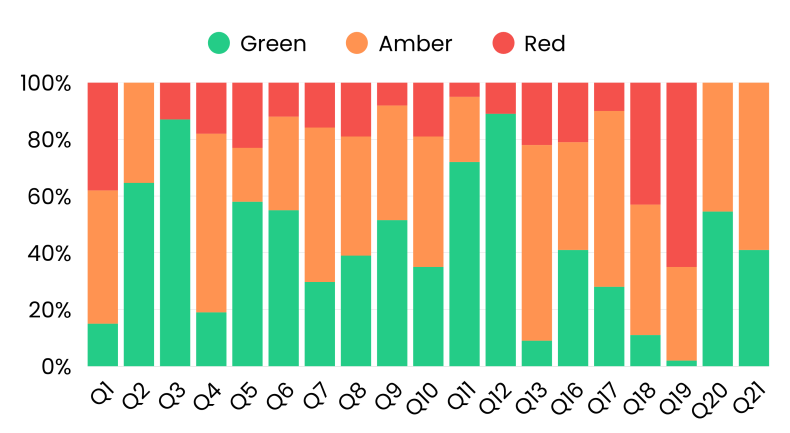
| Question summary | Red | Amber | Green |
Q1 | Job evaluation board reports and risks | 38% | 47% | 15% |
Q2 | Job evaluation HR lead / resources | 0% | 35% | 64% |
Q3 | Job evaluation staff side lead | 13% | 0% | 87% |
Q4 | Partnership receives job evaluation performance reports | 18% | 63% | 19% |
Q5 | Up to date job evaluation policy | 23% | 19% | 58% |
Q6 | 12-week timeliness recommendation | 12% | 33% | 55% |
Q7 | Job evaluation leads panel interaction monitoring system | 16% | 55% | 30% |
Q8 | Job evaluation lead involvement in service redesign | 19% | 42% | 39% |
Q9 | Job evaluation leads and practitioners keep up to date with relevant job evaluation matters | 8% | 40% | 51% |
Q10 | Job evaluation policy specifies capacity and backlogs | 19% | 46% | 35% |
Q11 | Job evaluation outsourcing | 5% | 23% | 72% |
Q12 | Job evaluation panels conducted in partnership | 11% | 0% | 89% |
Q13 | Sufficient no of practitioners (3-5) | 22% | 69% | 9% |
Q16 | Panellists representative of workforce | 21% | 38% | 41% |
Q17 | Paid time off for job evaluation practitioners | 10% | 62% | 28% |
Q18 | Job evaluation refresher training | 43% | 46% | 11% |
Q19 | Up to date job description | 65% | 33% | 2% |
Q20 | Job evaluation recording systems | 0% | 45% | 54% |
Q21 | Job evaluation report for staff | 0% | 59% | 41% |
Please note: For full question wording, see Appendix 1.
While some organisations have well established job evaluation processes and demonstrate good compliance with the NHS Job Evaluation Scheme, the audit found significant variation in job evaluation maturity across the NHS in three key areas:
- governance and assurance
- partnership working
- job evaluation capacity and capability.
The audit is not a pass-or-fail exercise. Rather, it provides an opportunity for employers and trade unions to work together to strengthen local job evaluation arrangements, reduce organisational risk, and build trust and confidence in the NHS JES and banding outcomes.
Employers and trade union representatives are encouraged to work together to review their organisation’s findings and agree, in partnership, an improvement action plan. This plan should address local findings, have clear priorities, milestones and timescales for improvement.
Please note: all organisations have access to their own result and to a dashboard of findings provided by NHS England that also may be useful to take into consideration.
To support these plans, guidance and advice for improvement in each of the three priority areas is given below.
The most successful organisations will be those that treat job evaluation as a strategic workforce issue supported by strong governance, genuine partnership working and a sustained commitment to build and ensure local capability.
Theme 1: Governance and assurance
Why governance matters
Boards are responsible for ensuring:
- staff are paid correctly
- equal pay risks are identified, monitored and addressed
- job evaluation is undertaken fairly, consistently and transparently
- sufficient resources are available to support job evaluation activity
- compliance with national requirements.
Key audit findings
As noted above, the overall audit findings show a mixed picture of job evaluation maturity and robust application with some employers reporting good practice in many questions. However, the NHS Staff Council notes with concern that:
- 15 per cent of organisations provide regular job evaluation reports to their board.
- almost one quarter do not have a local job evaluation policy
- nearly half rely on local spreadsheets to record job evaluation activity
- 41 per cent are confident they can provide a job evaluation outcome report if requested by staff
- 2 per cent have a robust process to ensure job descriptions remain accurate and up to date
- 28 per cent outsource some or all of the job evaluation work to another organisation including private companies.
What does this mean?
Strong governance arrangements help organisations provide assurance that job evaluation is being applied fairly, consistently and in accordance with national guidance.
Without effective oversight and procedures, organisations may be exposed to:
- reduced confidence in job evaluation outcomes among staff and trade unions
- increased equal pay risks
- breach of contract risks
- industrial relations disputes
- financial pressures arising from incorrect banding
- difficulty providing assurance or audit evidence.
How to improve
For boards and executives
- Receive regular reports on job evaluation activity, performance, risks and workforce impacts (at least annually, ideally quarterly).
- Understand any workforce, financial and industrial relations risks associated with JE activity. Ensure they are reflected within existing governance arrangements and risk registers/management arrangements.
- Seek assurance that JE performance, panel activity, timescales, delays and backlogs are being actively monitored.
For job evaluation leads (management and staff side) in conjunction with partnership forums/joint negotiating committees (JNCs)
- Review and update local job evaluation policies and procedures to ensure they are consistent with the NHS JE Handbook and Annex 31.
- Regularly review local governance arrangements and reporting mechanisms.
- Monitor job evaluation activity, outcomes, trends and emerging risks through partnership structures by committing to a regular agenda item on partnership forum/JNC agendas.
- Support the development of local processes to ensure job descriptions are kept up to date.
For people teams in conjunction with partnership forums/JNCs
- Develop robust local processes for reviewing and maintaining job descriptions, a requirement now outlined in Annex 31 of the NHS TCS Handbook.
This will need to include consideration of the following:
- An audit of the current state of job descriptions and agreement on actions needed as a consequence of its findings.
- How job descriptions will be stored, accessed and version controlled.
- How job descriptions will be reviewed periodically and when significant role changes occur.
- How staff can access the current job description and most recent job evaluation report for their role.
- How staff and line managers can ensure job descriptions are updated when roles change.
For managers
- Review job descriptions regularly (minimum of every three years) and discuss and agree duties and responsibilities with staff.
- Engage with job evaluation leads early when services are redesigned or new roles introduced.
- Ensure staff are aware of local job evaluation processes and how changes to roles will be considered.
- Support staff participation in job evaluation activity where appropriate.
Local job evaluation policies
The policy should clearly describe local arrangements for administering and managing job evaluation activity, and include the following:
- key performance indicators (KPIs) for reporting purposes
- panel planning and composition
- workflow and workload management
- roles and responsibilities
- practitioner release*
- consistency checking
- record management and retention
- dispute resolution processes, including disagreements about job description content.
Policies should also explain how the organisation will:
- promote equitable access to job evaluation across all staff groups and pay bands
- maintain accurate and up to date job descriptions
- monitor job evaluation activity and outcomes
- protect the integrity of the scheme while ensuring staff have appropriate access to review processes where there is evidence that duties, responsibilities or job demands have changed.
(*Release for staff-side job evaluation panellists should be agreed locally and must not be counted as facilities time).
Theme 2: Partnership working
Why partnership matters
The NHS Agenda for Change pay structure, and its Job Evaluation Scheme, is underpinned by partnership working between employers and trade unions.
Effective and constructive partnership working helps to:
- ensure that job evaluation processes are fair, transparent, and consistently applied
- improve confidence in outcomes
- identify and resolve issues early
- build positive employee relations
- maintain the integrity and credibility of the JES.
Key audit findings
As noted above, the overall audit findings show a mixed picture of job evaluation maturity and robust application with some employers reporting good practice in many questions. However, the NHS Staff Council notes with concern that:
- 14 per cent of organisations completed returns without staff side involvement
- 13 per cent have no staff side job evaluation lead
- 19 per cent report job evaluation activity regularly to partnership forums
- 11 per cent do not conduct panels in partnership
- 28 per cent have arrangements that ensure practitioners are released to undertake job evaluation work.
What does this mean?
Where partnership arrangements are weak, organisations may experience:
- reduced confidence in job evaluation outcomes
- increased risk of disputes and challenges
- delays in job evaluation activity and decision-making
- inconsistency of outcomes
- damaged trust between employers and trade unions.
Strong partnership working promotes transparency, consistency and shared ownership of job evaluation arrangements, supporting confidence that the scheme is being applied fairly and consistently.
How to improve
For employers
- Ensure there is a dedicated employer-side JE lead *.
- Ensure staff side representatives are involved in JE governance, oversight and improvement work and given partnership time off to participate.
- Make JE a standing item at partnership forums.
- Share job evaluation performance, risks, activity and workforce information openly and regularly with their joint negotiating and consultative committee (JNCC) or partnership forum.
- Support the release of both management and staff-side practitioners to undertake job evaluation work, training and consistency checking.
For staff side
- Nominate a recognised staff side job evaluation lead. This person will be accountable to the JNC and will require adequate time and resources to undertake this role.
- Support recruitment, development and mentoring of new staff side practitioners.
- Help identify and escalate barriers preventing practitioner participation.
- Promote awareness of job evaluation developments and learning opportunities.
- Work constructively with employers to identify priorities for improving local job evaluation practice.
(*It will be helpful to agree the remit of both staff side and employer side job evaluation leads.)
Partnership forum discussions
Regular partnership oversight provides an opportunity to jointly identify issues, agree solutions and ensure local job evaluation arrangements continue to operate effectively, fairly and in line with national guidance.
job evaluation should be a regular agenda item at JNC/partnership forums to enable oversight of local arrangements and to monitor progress against actions to improve job evaluation practice. Suggested content for these discussions includes:
- number of job evaluation panels completed, and outcomes recorded
- any capacity challenges, including succession planning
- training requirements of practitioners (including refresher training)
- length of time for a job to go through job evaluation process and any backlogs
- outcomes of consistency checking and any emerging themes (for example, are jobs regularly sent back to the original panel)
- ensuring all panels are done in partnership
- agreement and discussion of quarterly and annual job evaluation audit data returns and reporting requirements
- improvement actions and progress against agreed plans
- emerging risks and resource requirements.
Theme 3: Building job evaluation capacity and capability
Why capacity and capability matter
Effective job evaluation depends on having sufficient numbers of trained and supported practitioners from both employer and staff-side to undertake job evaluation activity.
Without this capacity, organisations may struggle to apply the scheme consistently, maintain timely processes, and retain confidence in job evaluation outcomes.
Therefore, building and maintaining local capacity and expertise helps ensure that job evaluation arrangements remain sustainable, resilient and aligned with national guidance.
Key audit findings
As noted above, the overall audit findings show a mixed picture of job evaluation maturity and robust application with some employers reporting good practice in many questions. However, the NHS Staff Council notes the following with concern:
- A reliance on outsourcing in some areas, and consequently job evaluation not being delivered in partnership.
- An imbalance of job evaluation practitioners within the overall pool. staff-side practitioners account for just over one in four job evaluation practitioners
- 59 per cent lack confidence that job evaluation panels are representative of all occupational groups.
- 11 per cent offer regular refresher training.
- 30 per cent have processes to support panel learning and development.
What does this mean?
Insufficient capacity to undertake job evaluation undermines confidence in the scheme and can lead to:
- increased delays and backlogs which may impact on recruitment
- reduced consistency
- over-reliance on a small group of practitioners
- reduced opportunities for learning and succession planning
- rreater reliance on external providers which in turn may limit the development and retention of local expertise.
How to improve
For employers
Build a sustainable practitioner pool -
- Assess current practitioner numbers, skills and capacity.
- Identify succession risks and future workforce needs.
- Agree a plan with the JNCC / partnership forum to attract and train practitioners from a range of occupational staff groups and pay bands. Work in partnership and provide support in order to increase staff side practitioner numbers.
- Encourage wider organisational representation.
- Seek to broaden the practitioner pool so that it reflects the diversity of the workforce.
Invest in training -
- Encourage local job evaluation leads to join the NHS Employers Community of Practice.
- Provide refresher training every three to five years, or sooner where required.
- Create opportunities for shadowing, mentoring and peer learning.
- Use panel feedback to identify learning needs.
- Share learning from consistency checking activity.
- Support practitioner release in policy and ensure release arrangements are agreed and monitored.
Support practitioner participation -
- Recognise job evaluation work as an important organisational responsibility rather than an additional activity.
- Agree and monitor release arrangements for both employer and staff-side practitioners.
- Ensure practitioners have sufficient time and support to maintain their knowledge and skills.
For staff side/staff side job evaluation lead
- Identify and support members from a range of occupational groups to be trained as JE practitioners.
- Support the development, mentoring and retention of staff-side practitioners.
- Encourage staff side practitioners to attend refresher training, update sessions and development sessions.
- Work in partnership to identify and address barriers that affect practitioner capacity and participation.
- Regularly report back to and escalate issues of concern relating to practitioner capacity, training or release arrangements through partnership forum/JNC.
Reducing reliance on outsourcing
What the audit found
The audit found that some organisations outsource some or all job evaluation activity to private providers, often in response to local capacity challenges. The NHS Staff Council has significant concern about the longer-term impact on local job evaluation arrangements this has.
Why this is important
The NHS JES is founded on partnership working between employers and trade unions nationally and locally.
Employers are legally accountable for ensuring pay equality and this includes all job evaluation activity and outcomes. Therefore, they will need to maintain sufficient local job evaluation capacity and capability to undertake job evaluation activity through local partnership arrangements, with outsourcing used only in exceptional circumstances where local solutions are not immediately available. This helps preserve local expertise, strengthen partnership working and maintain confidence in the integrity of the scheme. Sustainable local arrangements also help ensure that JE decisions are informed by an understanding of local roles, services and workforce structures.
The NHS Job Evaluation Handbook recognises that organisations may occasionally require additional support to address temporary capacity issues. Such temporary solutions should be time-limited, agreed in partnership and have clear measurable goals, which draw on the minimum amount of external support needed whilst building internal capacity. Consistency checking should remain an internal organisational responsibility and be undertaken locally by a trained partnership panel, to ensure fairness, transparency and confidence in outcomes.
See chapter 3 of the NHS JE Handbook for further information.
The NHS Staff Council is concerned about the risks of longer-term outsourcing which can -
- reduce internal expertise
- weaken local partnership working and shared ownership of job evaluation arrangements
- limit opportunities for staff-side practitioners to gain experience and develop skills
- reduce organisational knowledge and resilience
- reduce local ownership of job evaluation activity
- make it more difficult to identify and address equality, consistency and governance concerns
- undermine confidence in local job evaluation processes and outcomes.
For more on the risks of outsourcing job evaluation arrangements please see additional guidance (in particular pages 5 and 6) from the NHS Staff Council Job Evaluation Group.
Recommended approach
- Work in partnership with trade unions to build sustainable local job evaluation arrangements and reduce reliance on external providers.
- Where outsourcing is used, ensure clear governance arrangements are in place and maintain local partnership oversight of processes and outcomes.
- Develop a jointly agreed plan with staff-side to strengthen local capacity and bring job evaluation activity back in-house.
This plan should cover the following:
- establishing effective governance and partnership oversight arrangements
- identifying the resources required to support local JE activity, including administration requirements as well as leads and panellists
- agreeing a local policy and processes aligned to national guidance
- recruiting and training a sustainable pool of employer and staff-side JE practitioners including consistency checkers
- providing appropriate release arrangements for practitioners
- mechanisms to forecast and monitor demand, manage workload and identify future capacity requirements
- develop succession plans to maintain local expertise and capability.
Job evaluation improvement checklist
To help prepare for future annual audits, organisations should consider whether they can answer 'yes' to the following and take appropriate action:
Appendix 1 – Job evaluation audit 2026 full list of questions
Assessment of job evaluation practices audit – taken from NHS England’s technical guidance
The audit consists of 21 questions covering organisational governance, partnership arrangements, training and resources, panel capacity, timeliness, monitoring arrangements and record-keeping.
Questions are structured to provide an evidence-based assessment of whether organisations have the key components of a robust, fair and sustainable job evaluation system in place.


