Introduction
This toolkit has been developed to support health and care employers in delivering high-quality T Level industry placements. These placements are a vital component of T Level qualifications, giving students meaningful, hands-on experience in real health and care settings. By participating, employers play a crucial role in shaping the future workforce and helping students gain the practical skills and confidence they need to succeed in their careers.
This resource has been created in response to feedback from employer partners and education providers who asked for clear, practical guidance on how to structure and manage placements effectively. Building on existing best practice and lessons learned, this toolkit offers easy-to-follow steps, templates, and tips designed to make the process straightforward and rewarding for everyone involved.
The toolkit is intended for health and care employers, including hospitals, care homes, community health services, and other providers, who are considering or already offering T Level industry placements. It will also be useful for education providers looking to strengthen collaboration with employers.
This resource was developed by members of the Integrated Care System (ICS) Industry Placement Network, which is facilitated by the Department for Education (DfE), Gatsby Charitable Foundation and NHS Employers.
The ICS Industry Placement Network was established in 2023. It is an employer network that supports health and care organisations to provide high-quality industry placements. Network members formed a working group to identify the elements they felt were needed for a high-quality industry placement, and they form the basis of this toolkit.
* This toolkit and the template documents within it are provided for download and adaptation by organisations to use in their own workplaces and contexts. Full copyright information is outlined at the end of this resource.
Key elements of industry placement networks
High-quality industry placements will have:

Agreed objectives and criteria
Educational outcomes that meet employer needs ensure that classroom learning prepares students for work in the health and care sectors. The education provider and employer agreeing on specific objectives for the industry placement means that both the student and the placement team understand what the student needs to achieve. Clear criteria for what the industry placement will include and suggestions for activities mean that both parties know how it will be achieved.

Strong collaboration between education and healthcare providers
Students, education providers and the employers hosting industry placements need to understand what is expected of them. This starts with the T Level provider and the employer building a strong partnership. The industry placement agreement supports both organisations to do this.

On-placement support for students
Creating a supportive environment means students feel comfortable to ask questions and seek guidance. Supervision and mentorship make sure that every student is supported and encouraged to actively engage in the delivery of patient care, which is the crucial hands-on experience that enables their learning. Supervision also means they can experience a diverse range of cases and clinical settings; this broadens learning and helps them adapt to different situations.

Regular evaluation and constructive feedback
Industry placements include regular feedback meetings at identified points during the placement to enable continuous improvement. Mentors play a big role in these meetings and the student–mentor relationship is key to the success of industry placements. Mentors guide a student’s learning and support them to understand what progress they have made and what they need to work on.
For staff who want to take on this role, there is support for industry placement mentors. This training also suggests ways mentors can support students during feedback meetings, including using a model such as GROW (goal, reality, options, way forward).
Below are some questions to help mentors guide feedback sessions:
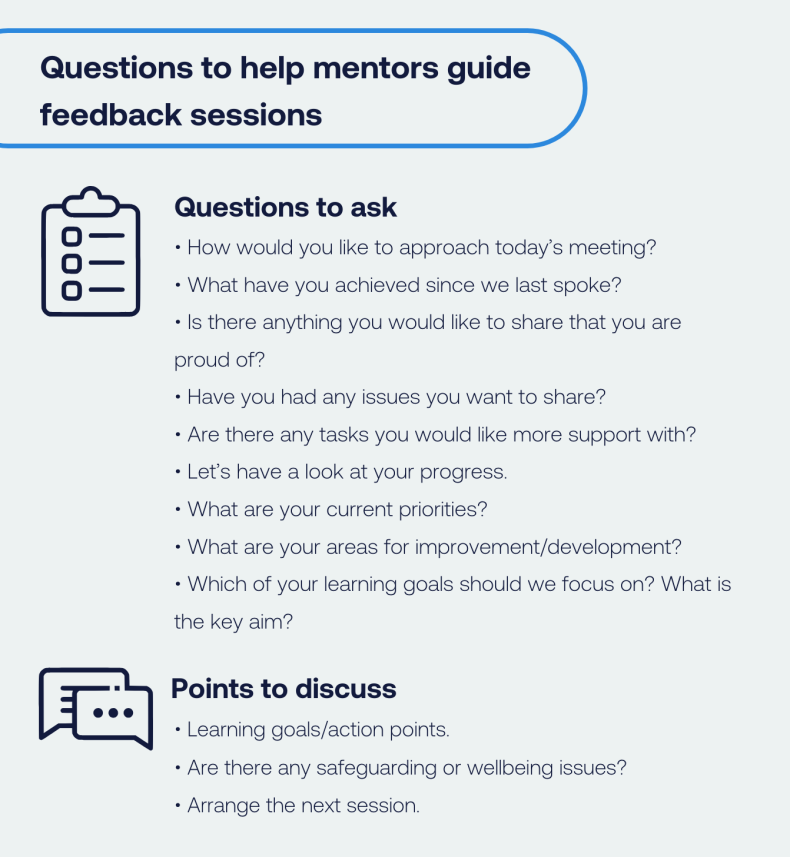
Download questions (PDF).

Adherence to health and safety regulations and industry standards
Work taster activities can be designed with the employer to highlight workplace regulations and industry standards, such as infection prevention and control, uniform requirements and mobile phone usage. The employer’s governance structure must also support hosting T Level students on industry placement, so it should consider updating or putting in place a young person policy, work experience policy and risk assessments to include T Level industry placements.
These five elements make sure students have meaningful practical experiences that prepare them for careers in health and care, but they also ensure that employers benefit from the students’ contributions during their placements.
Quality assurance resources
Using a student checklist helps assure the quality of the industry placement. The checklist template below sets out the tasks students can carry out in a clinical setting under supervision. They align with the Health T Level specification and are actual examples of what students are already doing in health and care organisations. The checklist also has space for the supervisor/mentor feedback and for students to reflect on the tasks.
Download student checklist (Word).
The assessment of student employability skills focuses on the soft skills students need to develop and it provides mentors and supervisors with a framework for giving constructive feedback to students, using criteria set by the Education and Skills Funding Agency.
Monitoring quality
It is important that every element of the industry placement continues to meet the expectations of the student, the employer and the education provider. To monitor this, it is essential to use feedback loops with those involved (student, mentor, supervisor). For example, gathering feedback from students to improve the experience for future cohorts can be done by asking two questions:
- What went well?
- What could have made the experience better?
The feedback should be reviewed to evaluate whether anything needs to be improved and any identified improvements must be implemented and monitored.
Guidance for providing a health and care sector industry placement
Many of the health and care employers that have hosted T Level industry placements have developed guidance. It is useful for both students and staff and it clearly sets out what the placement will involve and what is expected of the student and the employer.
Click the + next to each heading below to show more information and downloadable resources you can use:
Resources for mental health settings
The below resources are available for employers looking to introduce or expand a T Level industry placement offer in a mental health setting.
The T Level mental health placement risk assessment serves as a starting point, to be tailored to the local context, for identifying and mitigating risk factors for students in this environment. The document includes recommendations for employers on how it should be used and other supporting activities and documentation that links to the risk assessment.
To support the above risk assessment, the Health T Level curriculum has been mapped to mental health settings to help employers identify suitable tasks for T Level students. This will enable them to complement their classroom learning whilst on industry placement. As with the risk assessment, employers should tailor this to their local context and discuss proposed tasks with education providers.
This document is divided into the core Health T Level learning objectives and those of the occupational specialism supporting the mental health team. If students are studying another occupational specialism a mental health setting can still be a useful and relevant industry placement and linking the placement to learning objectives should be discussed with the education provider.
Further resources and information
Further resources
Department for Education resources
The DfE provides authoritative guidance for employers offering industry placements:
- Discover Your Future Workforce - this website is the official T Levels employer hub, providing guidance, resources, and tools for businesses to understand T Levels, connect with local education providers, and learn how to offer industry placements for students.
- T Level industry placements delivery guidance - this guidance outlines the key roles and responsibilities for providers and employers in delivering a consistently high-quality industry placement experience at each stage of the process.
- Specific information about industry placements for Health and Science T Levels - detailed advice and best practices for employers in health and science sectors, including how to structure placements, support mentors, and scale opportunities across departments.
Health Education England
Other resources that support the delivery of high-quality experiences in the workplace for young people are available. While not written specifically for T Level industry placements, they have useful information, templates and other resources that can be adapted by employers to support T Level students on industry placement.
These include:
- NHS England Workforce, Training and Education’s Work Experience Resource Toolkits for Health and Care Organisations - downloadable templates and guidance from Health Education England to help health and care organisations design and deliver high-quality work experience programmes.
- Work Experience Quality Standard Framework - this is a helpful framework. However, because it is not specifically for T Level industry placements, NHS organisations cannot use it to benchmark themselves as ‘gold’, ‘silver’ or ‘bronze’ T Level employers.
The ICS Industry Placement Network
The ICS Industry Placement Network is an employer network that supports those working in an ICS to provide T Level industry placements in the health and care system, as well as developing placement models for their areas. During quarterly network meetings and monthly lunch and learn webinars, employers and education providers share stories of best practice, highlight challenges and barriers, and troubleshoot issues collaboratively. Webinars have included an example of clinical placements in midwifery and hints and tips for working with under-18s.
The network also runs ‘share and exchange’ sessions alongside NHS Employers. Members submit questions or queries in advance but the sessions are free flowing conversations with participants.
The DfE supports the network with up-to-date policy information to help health and care organisations embed T Level industry placements and T Level graduates into future workforce strategies. The network also commissions research to gather evidence to support investment, for example reviewing the actual costs of hosting a placement, innovative placement models and progression opportunities.
For further information, please contact icsindustryplacementnetwork@gatsby.org.uk.
Acknowledgements
Copyright and use
© Gatsby Charitable Foundation [2026]. These template documents are provided for download and adaptation by organisations for their own use. Once downloaded and edited, responsibility for the content rests solely with the organisation using the materials. Gatsby Charitable Foundation accepts no liability for any use, adaptation, or reliance placed on these documents.


